
Ginger Bioactives: A Comprehensive Review
The review Dr. Natale points to for an evidence-informed look at ginger.
Read the article →Ginger has been used for the stomach for centuries. Here is a plain, doctor-reviewed look at what ginger is, what the research does and does not show for nausea and digestion, the forms people actually use, and how ginger fits alongside care from a doctor.

Ginger root has been part of cooking and home remedies for the stomach for a very long time, across many cultures. It is one of the most studied botanicals for nausea, and it is well tolerated by most people. This guide is a plain, doctor-reviewed look at what ginger is, what the research does and does not show for nausea and digestion, the forms people actually use, and how ginger fits alongside care from a doctor. It is general information, not medical advice.
Ginger (Zingiber officinale) is the knobby underground stem, called a rhizome, of the ginger plant. People have used it as a food, a spice, and a traditional remedy for the stomach for centuries, from fresh root and tea to dried powder. Its familiar warmth and bite come from natural compounds in the root, mainly gingerols and shogaols.
For most of that history, ginger has been reached for in the context of nausea, an upset stomach, and everyday digestive comfort. That long record of traditional use is exactly why it shows up in so many kitchens and cabinets, and why researchers have spent time studying it. It is a food-grade botanical, not a drug, and this guide sticks to how ginger relates to the stomach and digestion rather than the longer list of claims you will see on supplement labels.
Ginger is one of the more studied botanicals for nausea. Clinical studies and reviews have looked at ginger across several settings where nausea is common, and overviews that pool those reviews together describe a generally favorable but mixed picture. The U.S. National Institutes of Health, through its National Center for Complementary and Integrative Health, keeps a plain summary of where the evidence stands.
A few honest caveats are worth keeping in mind. The studies vary in size and quality, results differ from person to person, and ginger is not a treatment for any disease. The research most often discussed is about nausea and digestion specifically, so this guide stays in that lane and does not wander into broader health claims that are not well established. If you want to read the source material yourself, the references at the end link to NIH and to published overviews of the clinical reviews.
Ginger earns its place by being well tolerated and well studied for the stomach, not by being a cure for anything.Ryan Natale, MD
Dr. Natale's go-to article for an evidence-informed look at ginger's benefits.
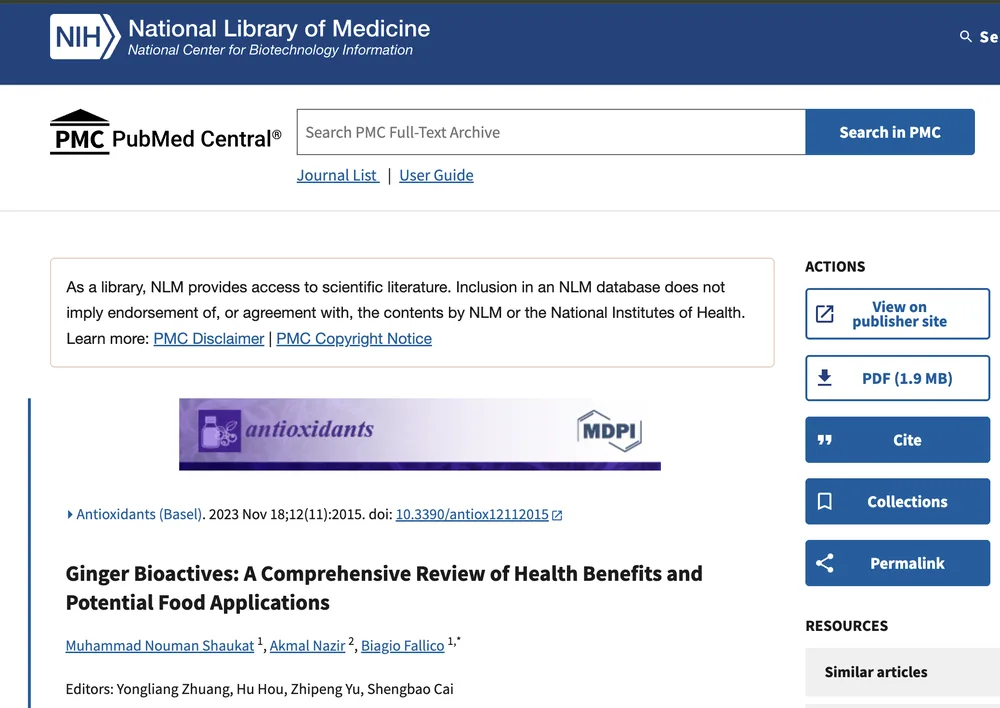
The review Dr. Natale points to for an evidence-informed look at ginger.
Read the article →Ginger turns up in a lot of forms, and people pick whatever is easiest:
The practical difference between these is how consistent the amount is. A cup of tea or a piece of fresh root gives you some ginger, but how much varies a lot. A measured ginger root extract is simply ginger concentrated to a known amount, so each serving is the same. That consistency is the main reason ginger shows up as a supplement at all, and it is why our own capsules use a set 200mg of ginger root extract rather than leaving the amount to chance.

Ginger is generally well tolerated by most people. At everyday food amounts it rarely causes problems. Some people notice mild effects such as a warm sensation, mild heartburn, or a little stomach upset when they take a lot at once. Supplement servings are usually described in a range of a few hundred milligrams to a gram or two per day across studies; our capsules use 200mg of ginger root extract as the ginger portion.
A few situations are worth a conversation with your doctor before adding a ginger supplement: if you are pregnant or nursing, if you take blood thinners or other prescription medications, if you have gallstones or a bleeding disorder, or if you have surgery coming up. Food-amount ginger and a doctor-reviewed product are different from loading up on high-dose supplements on your own, and your doctor can tell you what makes sense for your situation.
Ginger is for everyday digestive comfort. Reach out to a doctor, or seek in-person care if it feels urgent, for any of these:
A home remedy is not the answer to those. When in doubt, check in with a doctor.
Ginger is a companion, not a cure, and it is not a replacement for medical care. For a lot of everyday moments, a ginger tea or a ginger chew is all someone wants. But when nausea or an upset stomach keeps getting in the way, that is worth more than a home remedy, and a doctor can look at the whole picture and decide what is appropriate.
That is the idea behind The Gastronomy Project. Instead of asking you to take a separate supplement, a doctor-designed formula pairs 200mg of ginger root extract with a prescription-strength medicine in a single capsule, reviewed by a U.S.-licensed doctor and prescribed only if it is right for you.
A few independent, evidence-based sources I point people to. These are background reading on ginger, not claims about any specific product.
If you and a doctor decide prescription nausea support makes sense, The Gastronomy Project pairs 200mg of ginger root extract with a prescription-strength medicine in a single capsule, reviewed by a U.S.-licensed doctor and prescribed only if it is appropriate for you. For the longer thinking on why a doctor chose ginger as the companion ingredient, read why we chose ginger.
Ginger has a long history of traditional use for nausea, and it is one of the more studied botanicals for it. Published overviews of clinical reviews describe a generally favorable but mixed picture. Results vary from person to person, and ginger is not a treatment for any disease. For nausea that keeps you from holding food down, see a doctor.
Supplement servings are usually described in a range of a few hundred milligrams to a gram or two per day across studies. Our capsules use a set 200mg of ginger root extract as the ginger portion. A measured extract keeps the amount the same each time, which is hard to gauge from tea or fresh root.
Fresh root grated into food or steeped as tea, dried ground spice, candied ginger and chews, and supplements such as capsules and extracts. Ginger ale and ginger beer are often flavored and contain little real ginger.
Ginger is generally well tolerated by most people. Some notice mild effects like a warm sensation or mild heartburn at higher amounts. Talk with your doctor first if you are pregnant or nursing, take blood thinners or other medications, or have a bleeding disorder or upcoming surgery.
No. Ginger is a companion for everyday digestive comfort, not a replacement for medical care. When symptoms keep getting in the way, a doctor can review your history and decide whether prescription support is appropriate.
Ginger has been used for the stomach and everyday digestive comfort for centuries, which is its traditional use. It is not a cure for any condition. If an upset stomach is severe or persistent, that is worth raising with a doctor rather than treating at home.
Short explainers on what ginger is, what the research actually says, and why I built it into every formula.
Enter your email for a 20% welcome discount.
This guide is general information, not medical advice, and does not replace a conversation with your own doctor. Ginger is described by its traditional use for nausea and digestive comfort; these statements have not been evaluated by the FDA, and ginger is not intended to diagnose, treat, cure, or prevent any disease. Compounded medications are not reviewed by the FDA for safety, effectiveness, or quality, and are prescribed only if a U.S.-licensed doctor determines they are appropriate.
See doctor-reviewed options that pair 200mg of ginger root extract with a prescription-strength medicine, shipped to your door if it is right for you.
See online nausea treatment → Or read why we chose ginger